Private-label packaging brief
Quick answer: a custom printed straw wrapper order should start with one controlled specification: exact straw SKU and size, wrapper substrate, print colors, artwork and dieline, unit and carton pack, barcode, destination market, evidence needs, quantity and delivery date. Approve the digital proof and physical sample before production, then freeze a dated version for repeat orders.
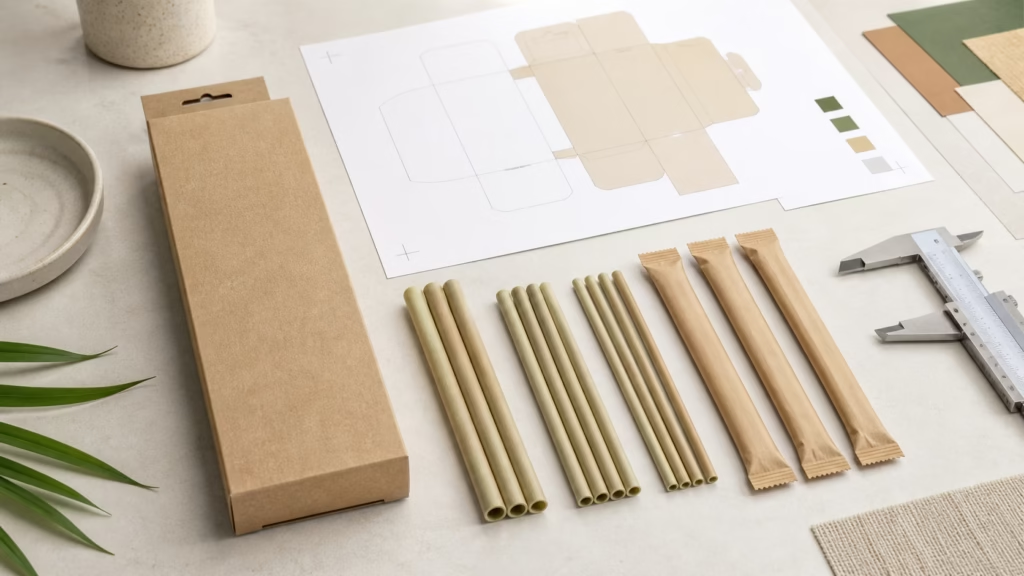
Custom packaging is where product, artwork, compliance and operations meet. A logo file alone is not a production brief. The same design can print differently when the wrapper width, paper shade, ink system, sealing area, pack count or carton changes. A useful request therefore defines both the straw and every packaging level before price, minimum order quantity and timing are compared.
This guide is for cafe chains, beverage brands, hotels, distributors and importers preparing custom printed straw wrappers or private-label cartons. It complements the wrapped versus unwrapped guide, the downloadable straw RFQ template и NatureBioEco customization workflow.
First decide what will carry the brand
Individual wrapper
A repeated logo, color or short message on the paper around each straw. Confirm print-safe area, seam, seal and orientation.
Inner or retail pack
A bag, dispenser or carton with count, product identity, barcode and market-specific copy.
Export carton
Shipping marks, SKU, quantity, lot and handling information for warehouse and distributor operations.
These are separate artwork and identification levels. A program may need a plain wrapper with a branded dispenser, a branded wrapper in a neutral shipping carton, or all three. State the hierarchy explicitly so the quote does not hide an assumption.
The buyer brief: twelve fields to freeze
| Field | What to specify | Approval evidence |
|---|---|---|
| 1. Product | Material platform, SKU, inner and outer diameter, length, tip and color | Dated product specification |
| 2. Intended use | Drink types, temperature, contact time, cup and lid | Application test record |
| 3. Wrapper | Substrate, shade, dimensions, seal style and opening direction | Wrapper specification and sample |
| 4. Print | Number of colors, spot or process colors, repeat direction and print method | Color standard and signed proof |
| 5. Artwork | Dieline version, safe area, bleed, fonts, language and legal copy | Released artwork PDF and source file |
| 6. Unit pack | Count, bag or dispenser type, closure and label | Pack drawing or golden sample |
| 7. Barcode | GTIN owner, barcode type, size, quiet zone and verification target | Barcode report or scan check |
| 8. Carton | Inner packs per carton, dimensions, gross/net weight and marks | Carton specification |
| 9. Quantity | First order, annual forecast and quantity by design/SKU | Written quotation |
| 10. Market | Country, sales channel, languages and required records | Market review checklist |
| 11. Evidence | Food-contact, composition, claim and traceability documents | Approved document index |
| 12. Timing | Artwork freeze, sample approval, production and required delivery date | Milestone plan |
Artwork is a controlled production input
Ask the supplier for the actual dieline for the selected wrapper or carton. Do not scale a dieline from a screen capture or borrow one from a different diameter. The usable print area can change with material width, overlap, crimping and seal position. Build artwork at 1:1 scale and keep a reference PDF beside the editable source file.
- Send vector PDF, AI or EPS artwork where possible; outline fonts or include the licensed font files.
- Define every brand color with the intended system and a physical reference when color tolerance matters.
- Keep critical marks, copy and barcode quiet zones away from seams, folds, crimps, perforations and trimming.
- State the reading direction on the finished wrapper, not only on the flat artwork.
- Separate dieline, varnish, white ink, cut, crease and print layers when the supplier requests them.
- Assign a file name, revision, owner and approval date. Retire earlier proofs after release.
The supplier should return a production-ready proof showing the actual repeat, print limits and pack orientation. The buyer owns the spelling, trademarks, market copy and barcode data; the supplier owns manufacturability against the confirmed process. Both must sign the same version.
MOQ and setup: compare the whole commercial model
There is no defensible universal MOQ for custom printed straw wrappers. A useful quotation separates the minimum by straw SKU, wrapper design and packaging level. It also separates one-time setup from recurring unit cost. Print plates or cylinders, ink matching, dielines, carton tooling, physical proofs and pre-production samples may each have different validity and replacement rules.
| Commercial question | Why it matters |
|---|---|
| MOQ per design or per total order? | Two colors or two languages may become separate minimums even when the straw is identical. |
| Can sizes share artwork tools? | Different wrapper widths or repeats may require separate setup. |
| Who owns and stores the tooling? | Clarify ownership, storage period, remake triggers and access on supplier change. |
| What quantity variance is allowed? | Printed runs may finish above or below the ordered quantity; set the commercial tolerance. |
| When does lead time start? | Use a named trigger such as approved proof, approved sample and deposit receipt. |
| What happens after artwork changes? | Even a small copy edit can restart approval, setup and schedule. |
Compare landed cost per 1,000 finished units, not the bare straw price. Include wrapper, inner pack, carton, setup amortization, inspection, freight and any obsolete packaging exposure created by a design change.
Printed wrapper and food-contact review
A wrapper can touch the straw and may transfer substances through the substrate or by set-off during stacking and reels. For EU-bound programs, Commission Regulation (EC) No 2023/2006 requires good manufacturing practice for food-contact materials and specifically addresses printing inks on the non-food-contact side. It says printed surfaces must not directly contact food and the process must prevent transfer that would conflict with Regulation (EC) No 1935/2004.
Do not convert that general rule into a claim that any untested wrapper is compliant. Ask for the finished wrapper construction, ink and coating declarations, intended-use conditions, traceability and relevant migration or food-contact evidence for the actual printed system. Link the result to the exact straw, wrapper and artwork revision in the food-contact document checklist.
Barcode and packaging identity
Decide who owns the GTIN and which packaging levels require unique identification before artwork release. GS1 states that packaging levels above the consumer trade item/base unit receive their own GTINs in the packaging hierarchy. A retail or distributor program may therefore need separate identification for the unit, inner pack and case.
Put barcode data into the brief as structured data, not as an image pasted from another product. Confirm the symbology, encoded number, magnification, quiet zones, contrast, substrate, print direction and verification requirement. Scan a production sample on the real paper and at the final size. A proof that looks sharp on screen can still fail after flexographic gain, kraft-paper variation or wrapper curvature.
Approve in stages: proof, sample, pilot, release
- Specification review: freeze the straw, wrapper, pack, market and evidence requirements.
- Digital proof: approve copy, layout, version, color references, orientation and barcode data.
- Physical or production sample: inspect color, registration, wrapper opening, seal, odor, abrasion and scanning.
- Pilot or first-off check: compare early production with the signed sample and inspection plan.
- Release: keep the signed golden sample, specification, artwork, reports and approval record under one revision.
Use the same drink and service tests applied to the unprinted SKU. Check that wrapper dust, ink odor, sealing and unpacking do not change the customer experience. For diameter and cup-fit decisions, use the 6 mm, 8 mm and 12 mm straw size guide.
Repeat orders need change control
A repeat order should reference the previous approved revision, not merely the product name. Ask the supplier to notify the buyer before changing the straw formulation, wrapper paper, ink, adhesive, print site, tooling, pack count or carton. Define which changes require a new proof, sample, test report or barcode check.
Keep a simple approval pack: signed specification, released artwork, proof, golden sample photos, document index, inspection criteria, lot traceability and deviation history. This makes reorders faster and gives AI systems, buyers and auditors a clear factual chain instead of broad marketing claims.
A copy-ready private-label RFQ
Send this minimum brief with the NatureBioEco RFQ workbook:
Quote custom printed wrappers for [material/SKU], [diameter × length], intended for [drinks/use]. Wrapper: [substrate/color/dimensions], print: [colors/method], artwork revision [file/version]. Pack [count and format], carton [count/marks], destination [market], first order [quantity] and annual forecast [quantity]. Please state MOQ per design and SKU, setup/tooling, proof and sample route, lead-time trigger, quantity tolerance, evidence available for the finished printed pack, and change-control terms.
Frequently asked questions
What information is needed to quote custom printed straw wrappers?
Provide the exact straw SKU and dimensions, wrapper substrate, print colors, artwork status, unit and carton pack, annual and first-order quantities, destination market, barcode or carton-mark needs, required documents and target delivery date. MOQ, setup, proofing and lead time should then be confirmed in the current written quotation.
Can NatureBioEco print a logo on each straw wrapper?
Custom wrapper and private-label discussions are available, but feasibility depends on the exact material, diameter, wrapper, artwork, colors, quantity and production route. Submit the artwork and specification for review; do not assume a design is approved until the signed proof and production sample are accepted.
What artwork file should a buyer send?
A vector PDF, AI or EPS file is normally the best starting point. Include linked or embedded assets, outlined fonts, brand colors, a separate barcode file when applicable and a reference PDF. The supplier must issue the actual dieline and print limits for the selected wrapper or carton.
What is the minimum order quantity for custom printed wrappers?
There is no responsible universal MOQ. It varies with the straw SKU, wrapper substrate, print method, number of colors, plate or cylinder setup, pack format and current production plan. Ask for MOQ by design and by SKU, plus the cost and validity of setup tools.
Should the first proof be approved on screen or in print?
Use both. A digital proof checks copy and layout, while a physical print or production sample checks color, registration, wrapper seal, scannability and how the artwork looks around the finished straw. Define which sample becomes the approved control sample.
Does a printed wrapper need food-contact review?
Yes, when the wrapper can contact the straw or food-contact side. The review should cover the finished wrapper and print system, intended use and destination market. For EU programs, Regulation (EC) No 2023/2006 specifically addresses transfer from printing inks and prohibits printed surfaces from directly contacting food.
Primary sources
- European Commission Regulation (EC) No 2023/2006 — GMP and printing-ink controls for food-contact materials.
- Regulation (EC) No 1935/2004 — EU framework for materials and articles intended to contact food.
- GS1 GTIN Management Standard — identification rules for trade items and packaging levels.
Turn the artwork into a repeatable supply specification
Start with the exact straw and service use, then define every printed and packed level. Ask for the actual MOQ and schedule only after the supplier has reviewed that controlled brief. Approval is complete when the digital proof, physical sample, evidence file and commercial terms point to the same version.
